


The next generation of photovoltaic systems and battery storage solutions are set to become one of the key components of the energy transition, thanks to a technology that is still relatively little known today: grid-connected inverters. Thanks to this technological advance, renewable energy plants will in future be able to To take on the roles previously fulfilled mainly by fossil-fuel power stations. This has been recognised by experts and politicians alike. After all, grid-connected inverters are one of the key components of the System Stability Roadmap. One Step-by-step guide is firmly embedded in the Germany’s system stability strategy ... In this article, we explain why grid-forming inverters are so crucial to the electricity system of the future and what exactly lies behind the technology.
What is a grid-connected inverter?
Unlike conventional grid-tied inverters, they can actively help to stabilise the grid frequency, if faults or disruptions occur on the network. You ensure a stable electricity grid, even if the electricity system is fully excluding old power stations is running. Modern inverters literally generate the grid frequency, to which conventional grid-following inverters synchronise. They act as the clock signal. In short: they replace the electrical characteristics of large power stations with their rotating turbines.
It is absolutely essential to maintain a stable voltage and frequency on the grid. Grid-forming inverters react to fluctuations in a fraction of a second and prevent power cuts. In particular, when used in conjunction with battery storage systems, they can perform other important grid functions such as instantaneous reserve capacity, or even black start and grid restoration following a power cut. In doing so, they take over the grid-stabilising tasks previously carried out by fossil fuel power stations and enable a secure electricity system based on renewable energy sources.
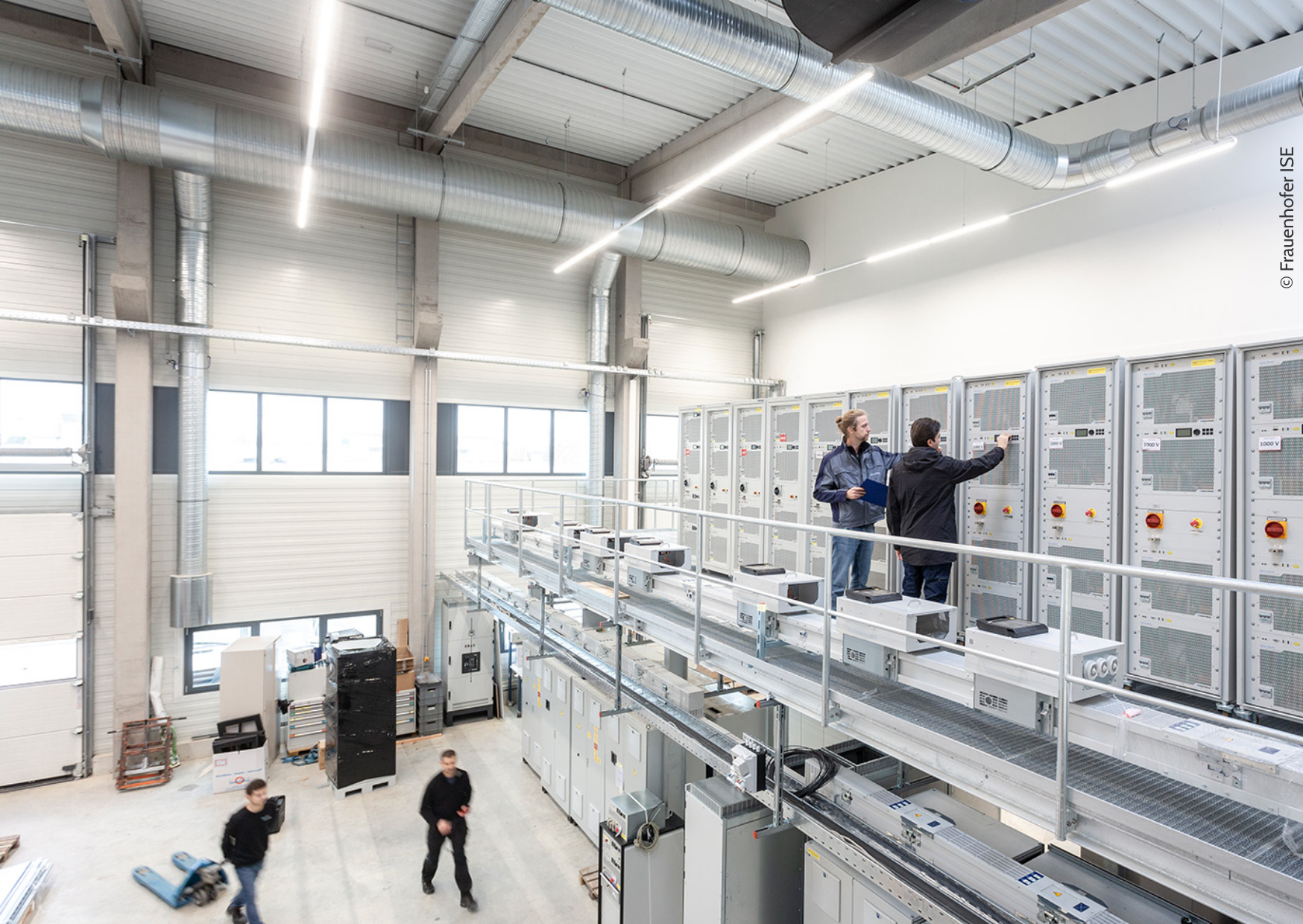
The Multi-megawatt lab at the Fraunhofer ISE in Freiburg (Source: Fraunhofer ISE).
How does a grid-connected inverter work?
A grid-connected inverter does not only operate with the Electricity gridbut it actively stabilises it. Unlike conventional grid-following inverters, it does not adapt to the existing voltage and frequency, but generates and controls these itself. The inverter actively injects its own voltage amplitude and frequency into the grid, much like a synchronous machine. Even in the event of short-term grid faults or voltage dips, the inverter remains stable on the grid. In the event of frequency or voltage dips lasting in the millisecond range, the inverter reacts – due to its physical design – by immediately providing instantaneous reserve power and reactive power, thereby stabilising the system independently and is capable of setting up an island grid or carrying out a black start entirely on its own. This makes it a a key component of a resilient electricity system based on renewable energy sources.
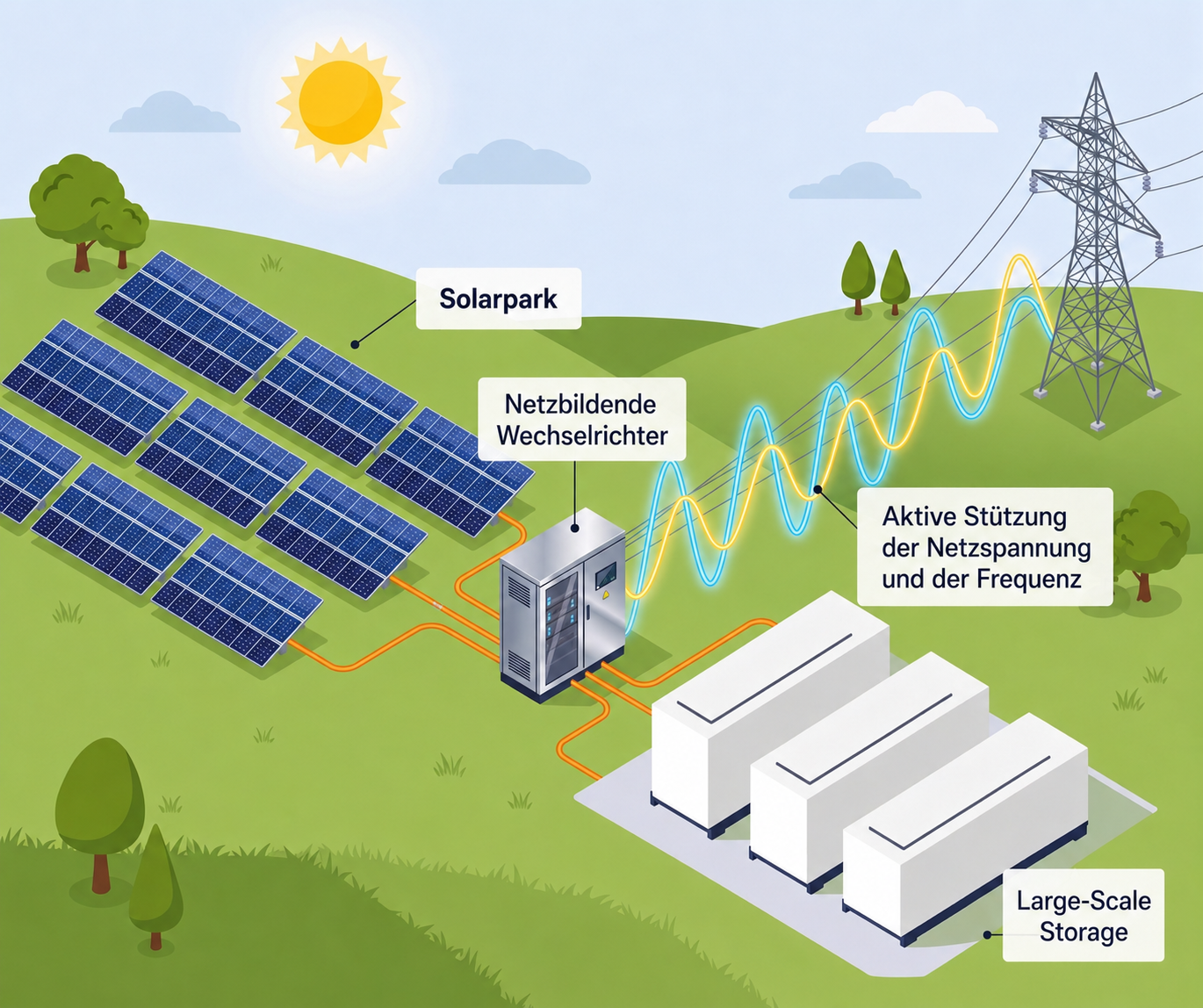
Diagram illustrating how a grid-connected inverter works (Source: Own illustration).
In our fact sheet on electricity grids, we explain in detail why a stable and efficient electricity grid is essential to the energy transition as a whole, and what challenges the grid expansion faces.
Why do we need grid-forming inverters in Germany?
Germany needs grid-forming inverters, because they form the basis of a stable electricity system powered by renewable energy sources. Traditionally, large power stations performed one key function: their rotating turbines generated „three-phase current“ (three-phase alternating current) and thereby maintained the frequency of the grid, which in Europe is 50 hertz. Due to the physical inertia Large power stations maintain this frequency at a stable level, and their electrical characteristics enable them to influence the voltage. These turbines also supply Reactive power, which is required to control power flow in the grid, and so-called short-circuit capacity, which is necessary to ensure that fuses trip safely in the event of a fault. Because the electricity system has to operate without large power station turbines, it is necessary to Inverters with grid-forming capabilities perform all these functions. Most inverters used in PV systems to date operate in grid-following mode. They have synchronised with the frequency set by large power stations. Now a new reference frequency is needed for the grid frequency.
Grid-connected inverters do exactly that. They automatically supply voltage and frequency and thus function, in electrical engineering terms, as a voltage source. Thus they stabilise the electricity grid even if Sun and wind fluctuate, or if Error in the network such as short circuits. Existing grid-following inverters can also synchronise with the new system clock. As long as older power stations are still in operation, the system remains stable through parallel operation. In a fully renewable electricity system, Grid-forming inverters: the cornerstone of system stability. You will be taken to a a key prerequisite for security of supply.
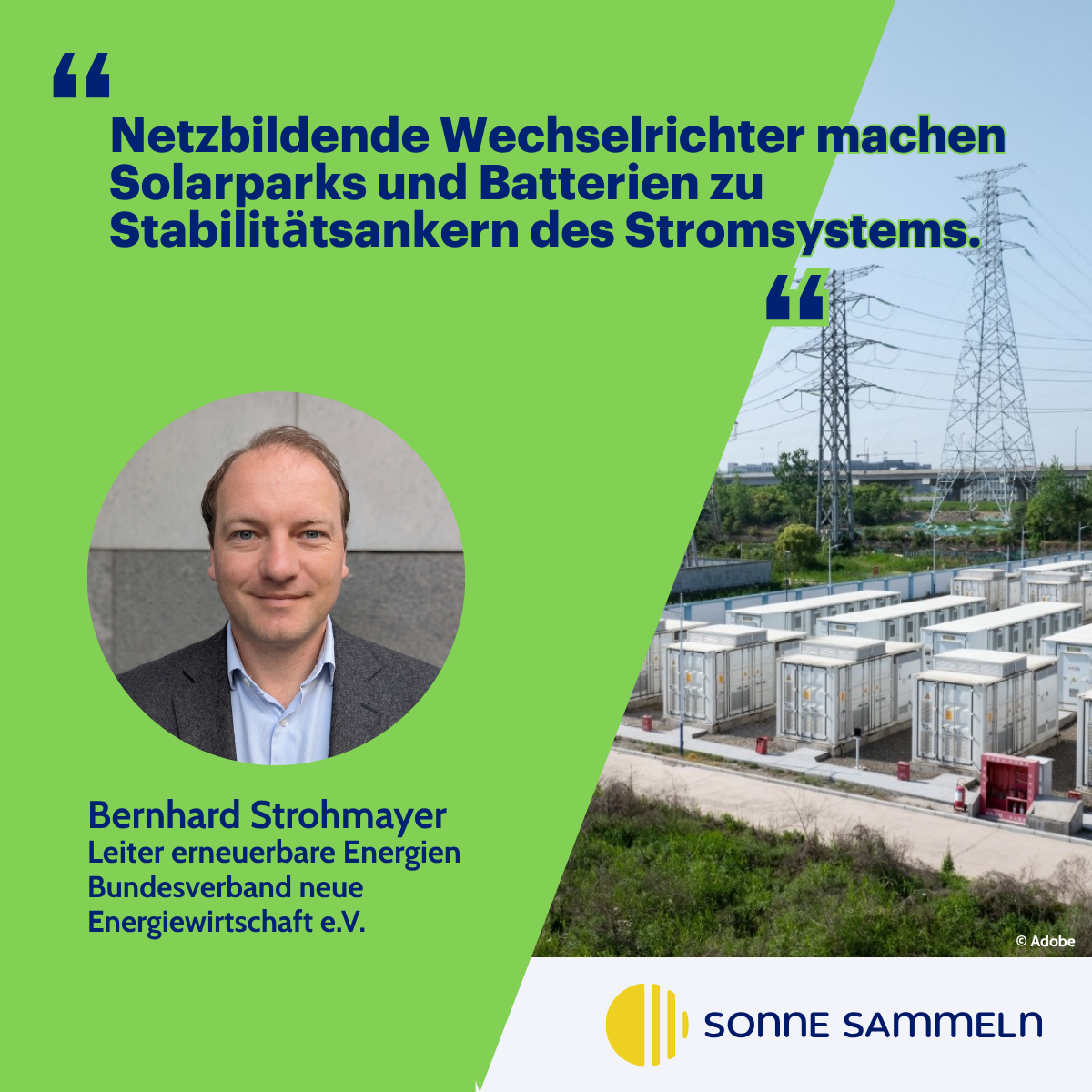
Bernhard Strohmayer (Head of Renewable Energy, bne) on grid-forming inverters.
Outlook
Grid-connected inverters are therefore far more than just a technical development existing inverter. They form the basis for ensuring that renewable energy taking responsibility for the stability of the electricity system in future can take over. The technology is regarded as one of the key building blocks on the path to a climate-neutral electricity system and is already firmly established in the The German Government’s plans on the future System stability enshrined.
But how far Is the technology actually real? Where do grid-forming inverters come from? already in use today And when will they become an integral part of the electricity system across the board? Which Requirements face network operators and what role do they play Funding schemes such as the Call for Innovation Proposals at the product launch?
We will be addressing these questions in the second part in our series on grid-forming inverters.

 English (UK)
  Deutsch