

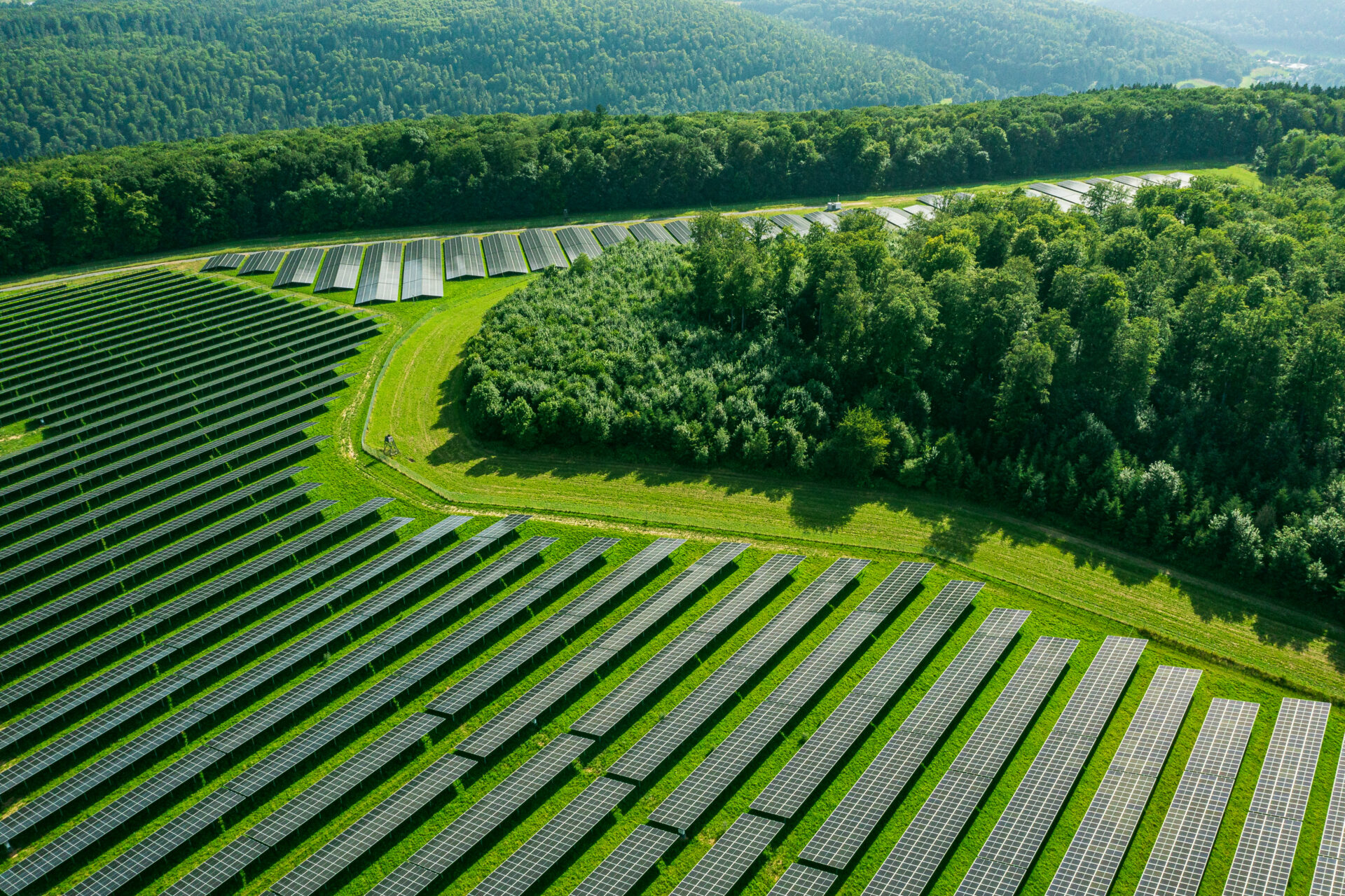
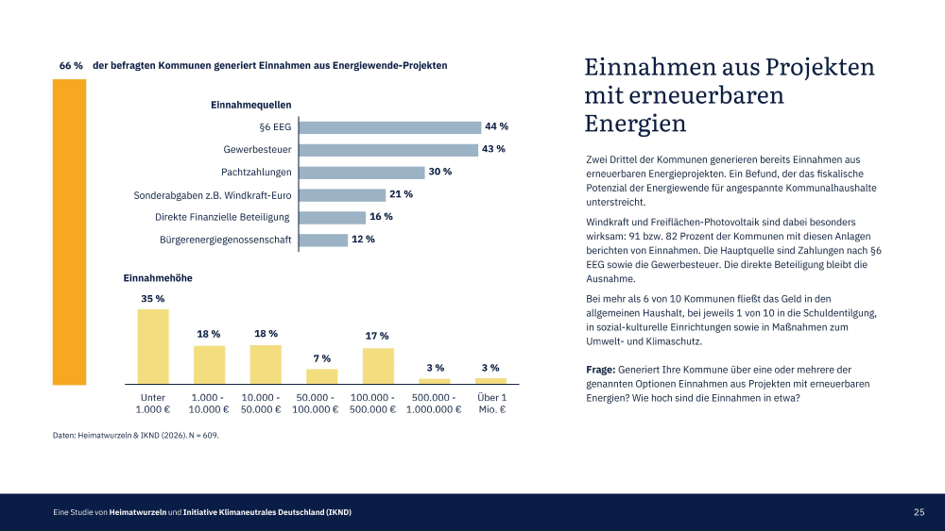
At a time when funds are tight, the energy transition is proving to be a lifeline for many local authorities. According to the IKND and the ‘Heimatwurzel’ survey Two-thirds of local authorities are already generating revenue from renewable energy projects. Solar farms play a key role in this, alongside wind power.
The three pillars of local value creation
Statistics show that solar parks are profitable: 82 % of local authorities with ground-mounted photovoltaic installations report direct financial benefits. These benefits are realised primarily in three ways:
- Business rates: Long-term revenue generated by the operating companies.
- Lease payments: When municipal land is used.
- Section 6: EEG payments: The legally enshrined share for local authorities per kilowatt-hour generated.
We explain how these funds can best be reinvested in our blog articles on local authority shareholdings, for example in Saxony’s Lossatal Parish.
Where does the money end up?
The study shows that in over 60 % of local authorities, the revenue is channelled into the general budget to fund key core functions. Around one in ten local authorities uses the funds specifically for debt repayment, social services or direct environmental and climate protection.
Local community participation under Section 6 of the EEG
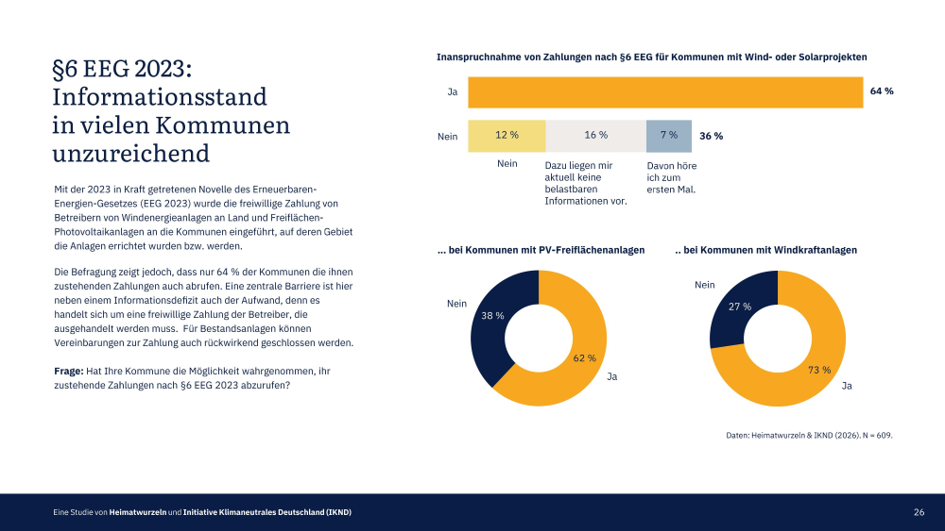
Section 6 of the EEG 2023 introduced a voluntary payment scheme whereby operators of ground-mounted PV and wind power plants make payments to the local authorities concerned. Since then, local authorities have also been able to receive a direct share of the revenue generated by solar and wind farms. Nevertheless, according to the survey results, over a third of the local authorities surveyed do not make use of the option to share in the proceeds under Section 6 of the EEG, as the chart below shows. The main barriers cited were a lack of information and insufficient capacity to negotiate such arrangements with the operators.
In addition, some federal states have enacted their own state laws on public shareholdings; an overview can be found at SonneSammeln. The lack of uniformity in the regulations across the individual federal states also entails risks, such as a Report by the Environmental Energy Law Foundation has found. It is particularly challenging for local authorities with small administrative departments to keep track of the various regulations and apply them effectively.
As a result, the Federal Association for New Energy Industries has recently issued a Proposal for updating local community participation in accordance with Section 6 of the EEG Published:
The legal opinion highlights existing weaknesses in local community participation in solar parks and sets out specific proposals for improving the resilience of the participation rules, with a particular focus on the integration of battery storage systems and the participation regulations of the federal states. Further information on this topic can be found in the accompanying Blog post.
Background:
The Nationwide survey of more than 600 mayors was organised by the Initiative Climate Neutral Germany (IKND) and heimatwurzeln e.V. initiated. The result: the energy transition at local level rarely fails due to a lack of commitment on the part of those in charge – but rather due to a lack of grid capacity, a lack of funding and complicated procedures. To mark the survey, we are publishing a series of blog posts on SonneSammeln highlighting selected findings.
In addition to this article, you will find Articles on survey results in the following subject areas Acceptance and Mains connections.

 English (UK)
  Deutsch